Our poem of the week is titled “Haiku”, but it obviously is not one. It comes to us from Kathleen Chartrand, who lives very near the Land of Oz in Wichita, Kansas. Haiku:
can
you swallow rocks rolled in the mouth of rivers or tasted by
fish? do
scales whisper truth flaking from slippery seers diving into
night? water
reflection gives mercy to past transgressions lingering from
guiltis
sea salty foam from endless tears? seaweed grabs, twisting
apart lieswhat
of the mermaid song illuminating night, crafting oyster
pearls?
Ten lines. That’s all you need. Our poem of the week is by a Michigan poet who has a few words of wisdom from his Grandpa. It comes from the fall issue of Third Wednesday, which will be in the mail to our subscribers in just a few days.
For
Life’s Dance
Grandpa
taught me to slow dance for
that first dance in fifth grade. Place
your right hand, just
firmly enough, on
her back, so
she can feel it, Then
she will decide if
she wants to move with you. That’s
all I remember – all
that ever mattered.
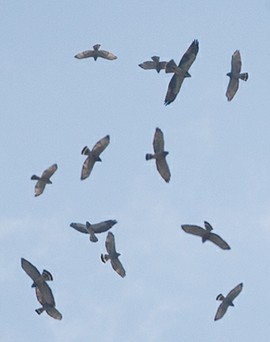
Unless you’re a birder, “kettling” may be word you’re not familiar with, an obscure word that is both title and subject of a poem by Lisa Timpf of Simcoe, Ontario. You may still want to look it up, but Lisa illustrates the meaning for us in a picture of words.
Kettling
no
vessel of heart or hand large
enough to encompass this
kettle of migrating raptors riding
the updraft coasting,
in lazy-winged spirals, while
we, like admiring ants, stand
clod-like and rooted to the earth so
far below
sharp-taloned,
keen-eyed afire
with a fierce and magnificent beauty they
speckle the overcast sky their
cries harsh and primal their
gyrations an echo of
the enigmatic circle of
life itself
Some poems seem ordinary until you come to the last line, which knocks you back on your heels. Here’s an example from Maine poet, Dave Morrison. This poem may not have made it into our summer issue without his final five words.
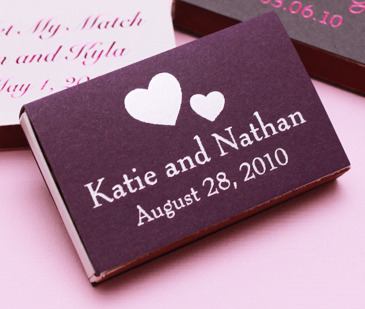
Wedding Matchbooks
When I was young, very
often you would attend a
wedding reception, and at
each place setting there would
be a book of matches with the
couples’ names, and the date
embossed on the cover.
It was a beautiful tradition;
weeks later you might light
a cigarette and wish Jerry and
Elaine a life of happiness, you
might throw a match on the
charcoal and remember Burt’s
funny and touching toast, you
might spark a firecracker and
wonder what the future held
for them, you might light the
pilot in the hot water heater
and wonder what went wrong.
We can’t resist those really short, pithy poems that come our way from time to time. Here are two from our Summer Issue by poets Mingzhao Xu and Gary Wadley:
The Launch
“Where are we going? I asked the rickety roller-coaster, edging upwards.
The old boards winked, “home,” then launched me into the sun.
Mingzhao Xu
San Diego, California
Cat
it is morning the first day
it is always the first day
I love a surprise ending. Our poem of the week is by Spencer Smith, who lives in Utah. The narrator asks a lady on the bus what’s inside her basket. Maybe curiosity really did kill the cat. I was also struck by how Spencer had me hooked from the first three lines. This is how you keep a reader reading.
Handbasket
It is not large enough to hold hell, though there may be some pieces inside that have broken loose.
The woman’s fingers, crimson-nailed, press tightly on the lid as if caught in the throes of a Beethoven chord.
She knows I am watching her, wondering what she is hiding; she rotates away from me like the face of the moon.
When it is time to board the bus I sit next to her as if by tragic accident. but she is not deceived.
It lies clenched in her lap, wicker lid breathing mystery. She unwraps her scarf and tents it over the handle.
I hear no sounds of creatures inside; no scent of zoo or decay hovers before me, no aroma of bread or berries.
She turns to me suddenly, angrily, lipstick red as her nails, and hisses that it is the shrunken head of her dead husband.
I suppose it serves me right. I smile at her. In these situations, I say, it is good to keep our heads.
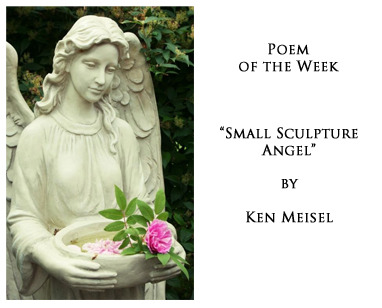
Cemeteries, oddly enough, are great places to find inspiration for some great poems. Think of Billy Collins riding his bike through a cemetery in Florida or Ted Kooser sitting on a cement bench in a cemetery in Iowa. In our poem of the week, we turn to Ken Meisel of Dearborn, Michigan for some musings about a “Small Sculpture Angel”.
The Small Sculpture Angel
– Mt. Kelly Cemetery
The small, sculpture angel, writhing over the resting stone, her cement hands clasping a bouquet of someone’s grieving funeral flowers, seems at first to you to be alive – her face, so tender and flushed chaste with afternoon sun, her eyes occupied with insects and moss, her small gown, dirtied by the season’s robust and feminine floral platter, and her tiny toes, emergent like rose beetles as she freezes here in perpetuity as you move closer to her to find her chronicle and her sculptural falsity, so imminent and so still. And, as you roam here, where the graves are solemn signatures of silence, you discover that she is not even alive here, and she is nothing – compared to the mother and her young daughter, these grievers you witness, so alive still, and so vast, with their own bird hands, like raw crows, slashing the roots and pottage out, where the graves, those silent tableaus of lost hours and echoes, wait – for living angels – those reliquaries, to come.
Casey is a great name for a baseball player, coach or, as it turns out, even a baseball poet. Here’s something for all you baseball fans and anyone who feels a kinship with the unusual. It comes to us from Casey Fuller of San Antonio, Texas.
Lament For The Knuckleballers
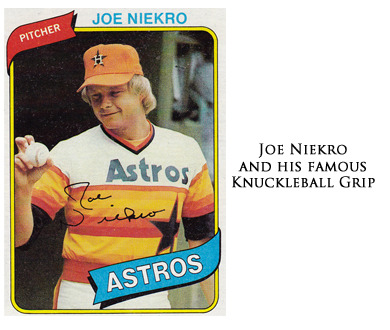
They began to die off. Fastball, slider, cutter, curve—from both sides, all decent hitters in The Show could get wood on anything near the plate and keep the count going. Even the change-up began to rise in miles per hour and every pitch began to look the same, swaying in one of two directions at the same speed. Everything at eye level, of course, was gone. Even the three and four batter, following the empirical rule of Metrics, began to languidly slap the outside stuff to the opposite side so the shift no longer worked and there was only the designated hitter to grumble about over fifteen dollar beers. Mirrors matched up in America, reflecting bad inside of bad, and everything soulful was glossed over, ganged up on, faked-news-ed, or gone. No one knew what was happening. Numbers began to let out a thick stench covering the game in a filmy, putrid yellow-green. Up in heaven, clouded quite differently, almost cracking his em-dash mouth with a smile, Ted Williams elbowed Tony Gwynn and said: Hell Tone, even you could hit 400 now. Joe Niekro died. Phil Niekro died. Charlie Hough wouldn’t talk. Tim Wakefield, as legend has it, wobbled off into a French village, happy to pay high taxes, and was never heard from again. Only the lowly assistant managers, with real piss and vinegar coursing through their Don-Zimmerman like veins had an idea. And only one or two of them wished they had a non-athlete up on the hill, lofting up improbable 59 mile an hour monarch butterflies, waiting to see if the catcher, outfitted in an oversized first baseman mitt, could snag the goddamn thing, because once upon a time, anything could happen in the greatest thing America ever invented, and so much was so unknown.
Our poem of the week is actually two poem by a talented poet from New York, Tiffany Babb. Tiffany demonstrates the power of the vignette when imagery paints the beginning of a story that the reader has to complete. She packs a lot into poems of just five and seven lines.
The Dock at Midnight
Beneath the black shadow of a bridge, the power of the unknown.
Lights glitter in a faraway patch of water, tiny mirrors reflecting the moon back into the sky.
All is silent. The ache too deep to ignore.
Curfew underneath the yellow light of streetlamps, fog swirls
the night thrums
along the street of closed bars, the muffled sounds of radios and brooms passing over shattered glass.

 Third Wednesday Magazine