Posts

Arriving Tangier

Our poem of the week is a preview of the Summer issue of 3rd Wednesday. Our featured poet, Lauren Tivey, sent a courageous group of poems, all set in Morocco. They begin with –

Arriving Tangier

The one-legged man is begging in the road.
Nearby, a boy is punching his horse
in the snout, dutifully, with neither wrath
nor glee. And the insane woman,

with her feet wrapped in bandages,
skin lesions oozing, is swathed
in a blood-red Moroccan flag
which barely covers her behind,

is muttering, is following us
down a dark street, is a nightmare,
a Burroughsian ghost, and we almost
run. Turning the corner, a street thief—

chased, caught, beaten with a shovel.
We are far from home, and we watch,
silent and grim: it is Ramadan and everyone
is angry. For comfort or for sport, we argue

as the night winds roll in, courtesy of the Strait,
scattering rats, lifting a sinister shroud off the city.
Gaunt strays whine among the garbage, while scraps
of newspaper surf over broken pavement, with some

sort of grace. But there is no grace anymore; not here,
not anywhere. You begin drinking more, to smooth
rough edges. This is not our first time—we have seen things
before. Tomorrow we will head inland, over scrubby plains

up to the Rif. We stand here at the tip of the continent,
all of Africa stretching in front of us, sensing the rumblings
of resentment shifting our marriage; that we may not
make it, that the times will try us, and break us

     – Lauren Tivey
     St. Augustine, Florida

Visit us at http://thirdwednesday.org/

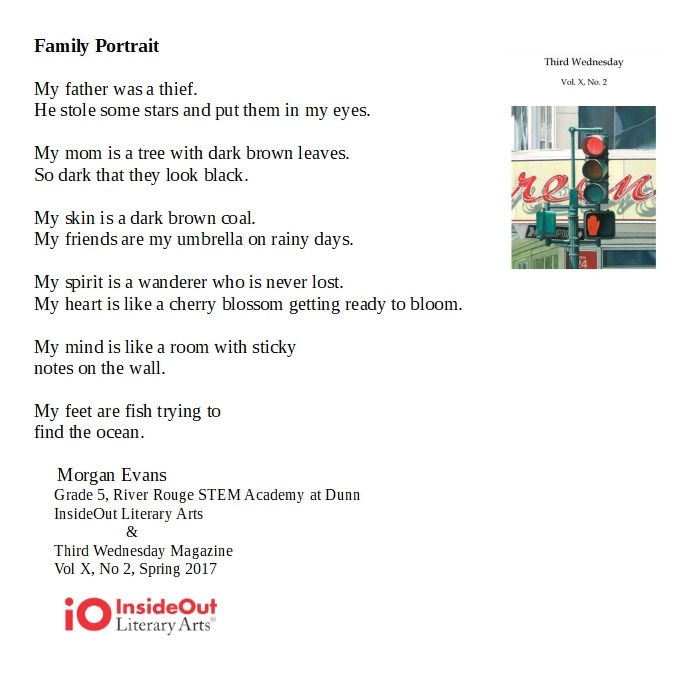
Family Portrait

Our poem of the week is drawn from our quarterly feature of “Inside Out,” an outreach program that brings poets into Detroit area schools to teach at all levels.

Family Portrait

by Morgan Evans (Grade 5, River Rouge STEM Academy at Dunn)

My father was a thief.
He stole some stars and put them in my eyes.

My mom is a tree with dark brown leaves.
So dark that they look black.

My skin is a dark brown coal.
My friends are my umbrella on rainy days.

My spirit is a wanderer who is never lost.

My heart is like a cherry blossom getting ready to bloom.

My mind is like a room with sticky
notes on the wall.

My feet are fish trying to
find the ocean.

Saturday

Our poem of the week is by Michigan poet, Joy Gaines-Friedler. It comes from a series of poems, nine of which were just published in our Spring issue of Third Wednesday. This one was chosen for its wonderful images.

Saturday

The sea surprisingly warm,
the sky a blue room I wait in. Fearless
pelicans plunge headlong into waves.

I walk the imagery of my mother’s life.
There are no birds in these images,
I have never seen her dip her toe into the tide

never seen her startled by stars, no wonderment
at the way water ripples or forms clouds.
She is never looking up.

Here in the space between waves
where a kind of sanctity floats
I praise what I can:

A porcelain blue saucer,
the smell of Aqua Net & acetate
nails polished Frank Sinatra smooth,  

the Formica table worn pale from hours of Solitaire,
cravings to leave – hers
                                        as much as mine.

I return to her room –  keep shut the blinds,
the way she always liked them.

The day clings to the edge.

Outside a cloud of a thousand starlings
move in unison, left then right – then left.
They land. Settled-in for the night.

Morel Hunting

Spring is finally here and some of us will soon be taking to the woods in search of the wily Morel mushroom,  Here’s our poem of the week from poet Brad Garber of Lake Owego in Oregon, who likes to talk to his prey while he’s stalking it. Whatever works Brad.

Morel Hunting  

It’s your wrinkled countenance I seek
There, beneath the duff, unassuming
Quiet secrets the mark of your being
Aspens, their young around you
Bowing in reverence. I have sought this
In others easier to discover, and louder
Voices calling out from the woods.

There are fireflies along the coast
Calling mariners home, confident
In their place, nothing hidden, nothing.
My boots scuff the ground, moving
Last year’s leaves, like ideas, aside.
All things lying in my way, hiding
Your delicacy, your mysterious choices
Like schools of fish, divert my advance.

In them, seeing myself, covering
The lens of the light until it sneaks
Into itself, erupting like a horn
From the animal beneath the earth
I will find the way to gather you.

Brad G. Garber
Lake Oswego, Oregon

Skiing In March

We’ve had our first day of spring, but it’s still March.  Here’s a poem from Canadian poet,  Susanne von Rennenkampff, that reminds us that spring may not be just around the corner in all parts of the world, and for some people, that’s cause for celebration.

Skiing In March

Maybe
if you forget it’s March,
forget that elsewhere
they’ve been wearing shorts
for weeks;

if you are suddenly
stopped in your tracks
by the intricate pattern
rising on the white trunk
of a birch, the rows upon rows
of silvery beads;
if you feel the bright splash
of rosehips on fresh snow,
crimson like blood
from the queen’s finger,
and do not flinch;

if you kneel down,
put your two fists
side by side
in the prints
of the moose
that crossed the trail
this morning;

maybe then
you will be grateful
that you still can ski
while elsewhere
snowdrops and primroses
have bloomed for weeks.

     Susanne von Rennenkampff
     Alberta, Canada

The Air Smelled Dirty

Massachusetts poet, Marge Piercy, remembers when houses were heated with coal.  My family referred to our coal furnace as “The Octopus”. 

The Air Smelled Dirty

Everyone burned coal in our neighborhood,
soft coal they called it from the mountains
of western Pennsylvania where my father
grew up and fled as soon as he could, where
my Welsh cousins dug it down in the dark.

The furnace it fed stood in the dank
basement, its many arms upraised
like Godzilla or some other monster.
It was my job to pull out clinkers
and carry them to the alley bin.

Mornings were chilly, frost on windows
etching magic landscapes.  I liked
to stand over the hot air registers
the warmth blowing up my skirts.
But the basement scared me at night.

The fire glowed like a red eye through
the furnace door and the clinkers fell
loud and the shadows came at me as
mice scampered.  The washing machine
was tame but the furnace was always hungry.

    Marge Piercy
    Wellfleet, Massachusetts

Slow Dance in the Kitchen

The best love poems avoid the use cliche words like love, heart, and soul.  Here’s an example from Connecticut poet, Gina Forberg.

Slow Dance in the Kitchen  

Clumsily he grabs my arm,
threads our fingers,
wraps his spare hand
around my baby fat waist.
Eyes a serious, recessive
blue inch up to my nose,
and he leads me, his arms
pointed, taut like a warrior
with a bow and arrow
toward the open window.
We spin in circles, feet light
on the cold tile floor
and I think of  how I still
have to make him lunch,
drive him to the bus stop,
but when I look at his
eyelashes like butterflies
blinking, nothing is more
delicious than this moment
and when he dips me
and presses his lips
a little too long,  
a little too hard
against mine,
I lose my balance,
grab his shoulders,
save myself from falling.

     Gina Forberg
     Fairfield, Connecticut

http://thirdwednesday.org/