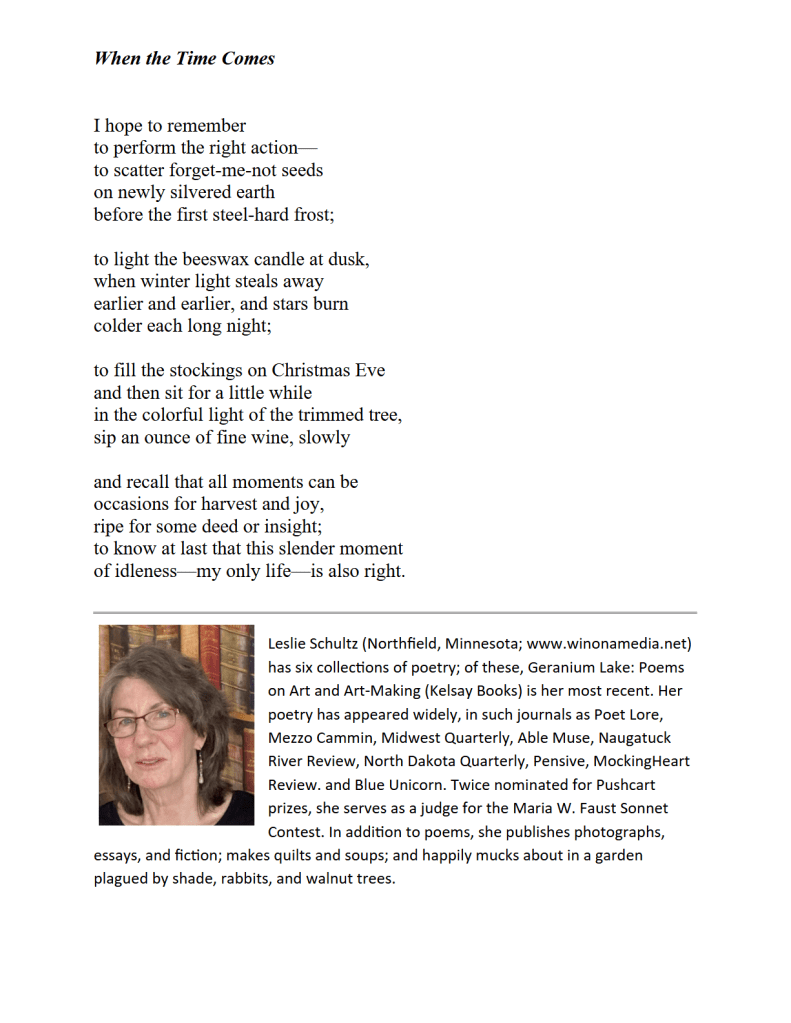
Tag: Leslie Schultz
Geranium Lake / Leslie Schultz
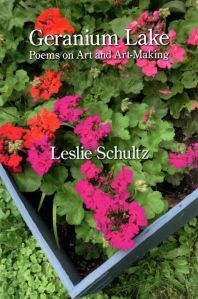 Named for a bold pink pigment that fades over time, Leslie Schultz’s vibrant collection Geranium Lake is an ekphrastic extravaganza as well as a meditation on age, time, and beauty. Schultz’s refreshing curiosity is evident as she engages with individual works of art and with larger issues of looking, curation, and display. Schultz’s eye for quirky details and her ear for playful sounds reminds me of that other great ekphrastic poet, Marianne Moore. “I know the struggle to make one / thing true,” reminding us that making art—and making a life—is a long process with endless twists and turns: “for each new page, dozens crumpled and torn.” For Schultz, the process is the point. Geranium Lake teaches us what it means to live a life devoted to apprehending, and making, beauty. This is one collection that won’t lose its luster no matter how much time passes.
—Melissa Range, author of Horse and Rider and Scriptorium
Art is where I find meaning, enjoyment, and a sense of accomplishment. Art expresses the depths and insights of life. I work primarily as a poet and photographer but also as a writer of fiction and essay.
—Leslie Schultz
https://winonamedia.net/
Geranium Lake: Poems on Art and Art-Making by Leslie Schultz
Kelsay Books, 2024
Available now from Kelsay Books and on Amazon.com
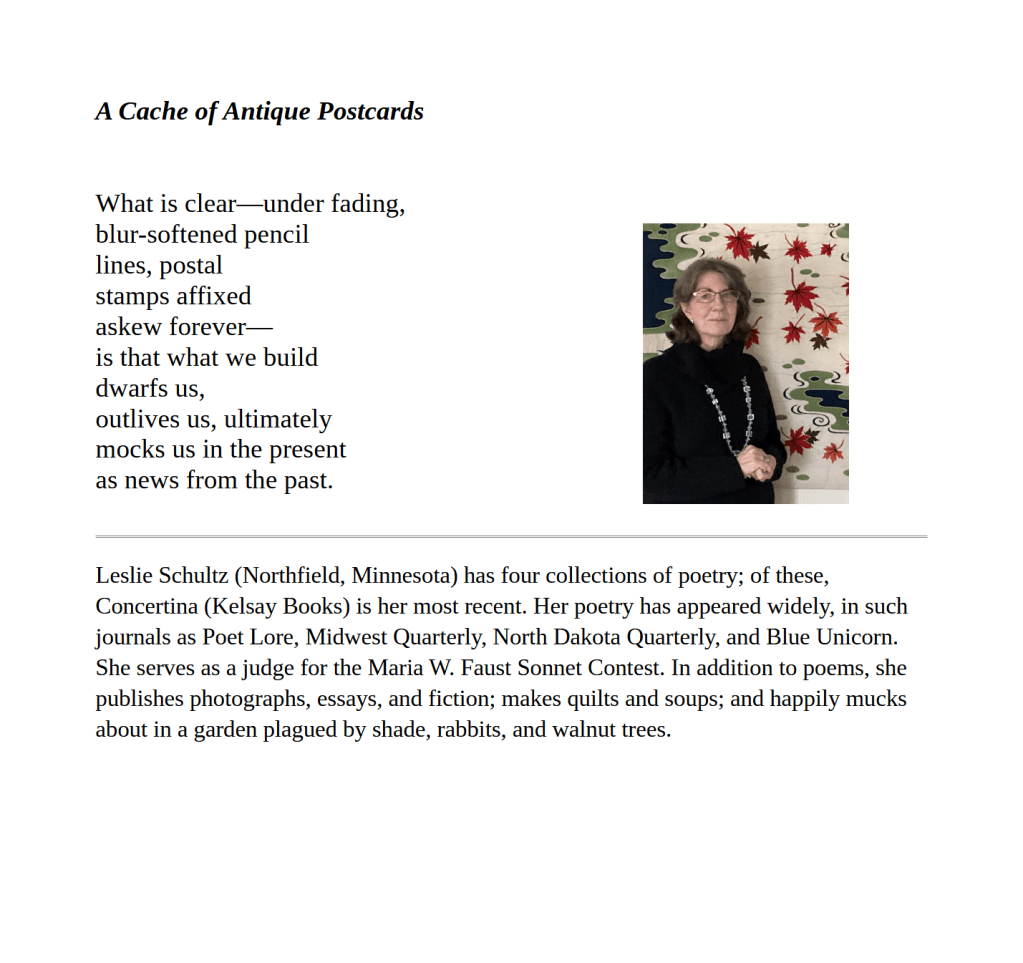
A Cache of Antique Postcards / Leslie Schultz
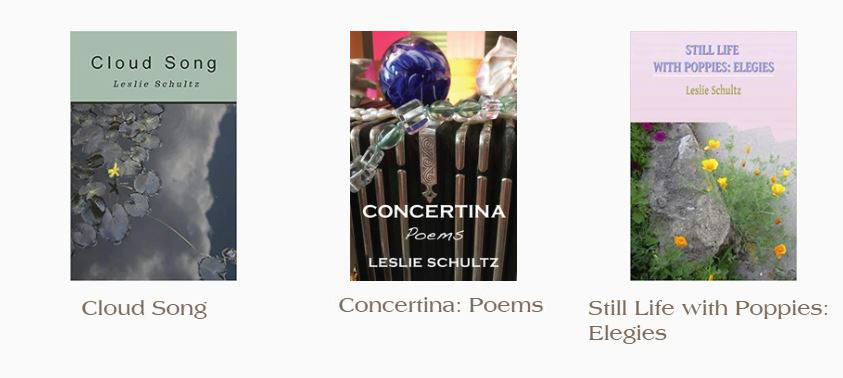
3 Books by Leslie Schultz
Available at Kelsay Books, Amazon & Content Bookstore in Northfield, Minnesota.
Leslie Schultz has been a frequent contributor to the pages of 3rd Wednesday Magazine.
Concertina
“Art sings a whole from a world in tatters,” writes poet Leslie Schultz in this remarkable collection. Schultz employs precise poetic forms to locate the “mineral music of our very bones.” The poems proclaim the material world – “the essential necessities… that make dreams real” – to celebrate poetry’s “ethereal alchemy.” Each poem creates a conversation between the poet and her many-layered audience. In “Open for Business,” the writer tells her father, “I’m still listening.” The poet’s voice here is accomplished, formal, witty, strange, and listening hard: to family stories, to nature’s notes, to the rooms of her house, to days “distinct with wonder.” In “Taproot,” a “crown” of 18 sonnets for and about Schultz’s great-great grandfather, each sonnet begins with the last line of the prior sonnet and transforms it to reshape the story. One sonnet turns an assertion to a question: “Can I build as lightly as birds/word shelters for the living and the dead?” This collection says yes. — Susan Jaret McKinstry
Cloud Song
In Cloud Song, Leslie Schultz is a master gardener. The beauty and abundance of her poetry springs from both a generous nature and a cultivated sensibility. Like the couple in her delightful character study “Gilbert’s Hobby,” she tends the “rampant garden” of free verse and the carefully shaped bonsai of formal verse with equal attention and skill. Her poetic garden is filled with sunlight and color and changing weather. What she offers is not an untouched Eden, but a real world populated by deftly-drawn characters existing in various states of fallen grace, a place where the poet’s attention always wanders from ideas of order toward the real beauty of the ephemeral: “sun slipping/behind the western trees, fish/tumbling in sparkles over the dam,/this garden in riots of color and seed.” — Rob Hardy
Still Life with Poppies: Elegies
Still Life with Poppies: Elegies by Leslie Schultz is what the name implies: bright joy against a sorrowful landscape. Death is everywhere in the world Schultz writes about—its relentlessness, its creativity, its suicidal call. Yet life in all of its various forms continues—some beautiful, some not. Cruelty may show its aftereffects for generations; a harsh set of comments may freeze creativity, at least for a time. While many may become cynical or depressed as a result, Schultz perseveres. Her poems about myth, in particular, are standouts. Schultz also understands in a profound way that the most emotional personal moments are mythical: emblemized by something as simple as plastic fruit in a blue bowl, or as iconic as a childhood home. For the depth of this understanding alone, you should read this book. — Kim Bridgford
 Leslie Schultz’s poetry has appeared in Able Muse, Blue Unicorn Journal, Light, Mezzo Cammin, Swamp Lily Review, Poetic Strokes Anthology, Third Wednesday, The Madison Review, The Midwest Quarterly, The Orchards Poetry Journal, and The Wayfarer; in the sidewalks of Northfield; and in a chapbook, Living Room (Midwestern Writers’ Publishing House). She received a Pushcart Prize nomination in 2017 and has twice had winning poems in the Maria W. Faust sonnet contest (2013, 2016). Schultz posts poems, photographs, and essays on her website: www.winonamedia.net.
Watch a video of Leslie reading on 3rd Wednesday’s YouTube channel.
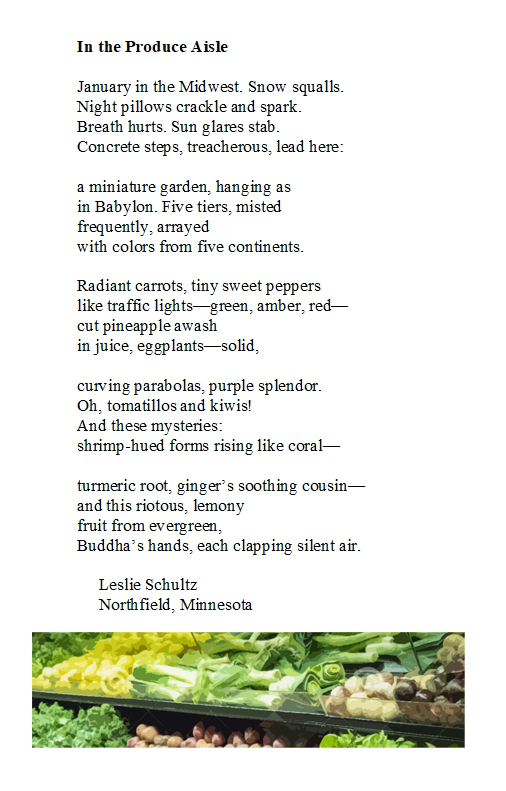
Dandelion / Leslie Schultz
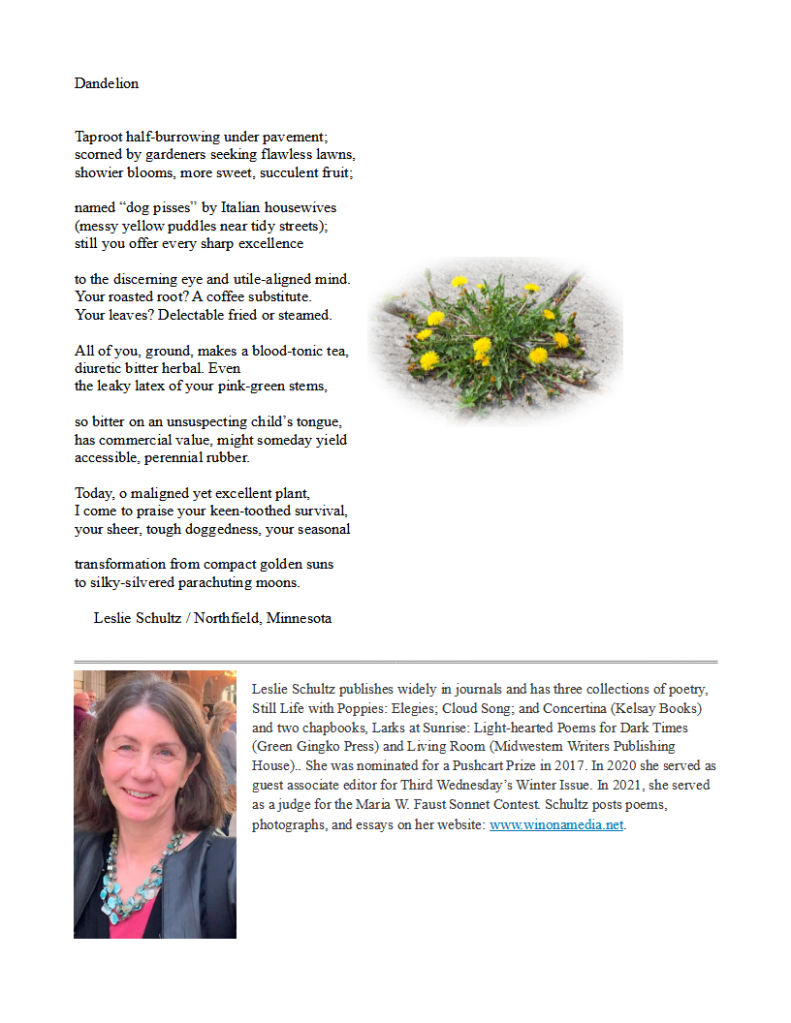
Memorial Day 2020 / Leslie Schultz
A good sonnet is hard to find. Here’s one from Leslie Schultz, who is currently helping us with reading for the winter issue of 3rd Wednesday. One of our editors commented: “”Memorial Day. . .”: Well-constructed sonnet, filled with what comes across as genuine emotion. YES.”
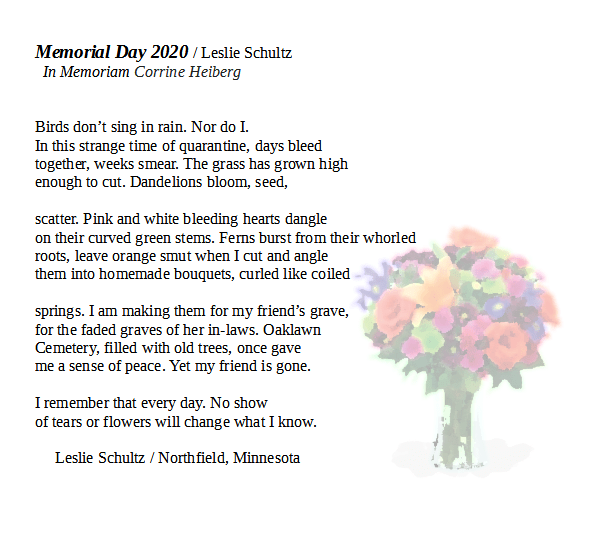
3 Books by Leslie Schultz
Available at Kelsay Books, Amazon & Content Bookstore in Northfield, Minnesota.
Leslie Schultz has been a frequent contributor to the pages of 3rd Wednesday Magazine.
Concertina
“Art sings a whole from a world in tatters,” writes poet Leslie Schultz in this remarkable collection. Schultz employs precise poetic forms to locate the “mineral music of our very bones.” The poems proclaim the material world – “the essential necessities… that make dreams real” – to celebrate poetry’s “ethereal alchemy.” Each poem creates a conversation between the poet and her many-layered audience. In “Open for Business,” the writer tells her father, “I’m still listening.” The poet’s voice here is accomplished, formal, witty, strange, and listening hard: to family stories, to nature’s notes, to the rooms of her house, to days “distinct with wonder.” In “Taproot,” a “crown” of 18 sonnets for and about Schultz’s great-great grandfather, each sonnet begins with the last line of the prior sonnet and transforms it to reshape the story. One sonnet turns an assertion to a question: “Can I build as lightly as birds/word shelters for the living and the dead?” This collection says yes. — Susan Jaret McKinstry
Cloud Song
In Cloud Song, Leslie Schultz is a master gardener. The beauty and abundance of her poetry springs from both a generous nature and a cultivated sensibility. Like the couple in her delightful character study “Gilbert’s Hobby,” she tends the “rampant garden” of free verse and the carefully shaped bonsai of formal verse with equal attention and skill. Her poetic garden is filled with sunlight and color and changing weather. What she offers is not an untouched Eden, but a real world populated by deftly-drawn characters existing in various states of fallen grace, a place where the poet’s attention always wanders from ideas of order toward the real beauty of the ephemeral: “sun slipping/behind the western trees, fish/tumbling in sparkles over the dam,/this garden in riots of color and seed.” — Rob Hardy
Still Life with Poppies: Elegies
Still Life with Poppies: Elegies by Leslie Schultz is what the name implies: bright joy against a sorrowful landscape. Death is everywhere in the world Schultz writes about—its relentlessness, its creativity, its suicidal call. Yet life in all of its various forms continues—some beautiful, some not. Cruelty may show its aftereffects for generations; a harsh set of comments may freeze creativity, at least for a time. While many may become cynical or depressed as a result, Schultz perseveres. Her poems about myth, in particular, are standouts. Schultz also understands in a profound way that the most emotional personal moments are mythical: emblemized by something as simple as plastic fruit in a blue bowl, or as iconic as a childhood home. For the depth of this understanding alone, you should read this book. — Kim Bridgford
Leslie Schultz’s poetry has appeared in Able Muse, Blue Unicorn Journal, Light, Mezzo Cammin, Swamp Lily Review, Poetic Strokes Anthology, Third Wednesday, The Madison Review, The Midwest Quarterly, The Orchards Poetry Journal, and The Wayfarer; in the sidewalks of Northfield; and in a chapbook, Living Room (Midwestern Writers’ Publishing House). She received a Pushcart Prize nomination in 2017 and has twice had winning poems in the Maria W. Faust sonnet contest (2013, 2016). Schultz posts poems, photographs, and essays on her website: www.winonamedia.net.
Watch a video of Leslie reading on 3rd Wednesday’s YouTube channel.
 Third Wednesday Magazine