
3rd Wednesday Magazine’s Annual Poetry Contest
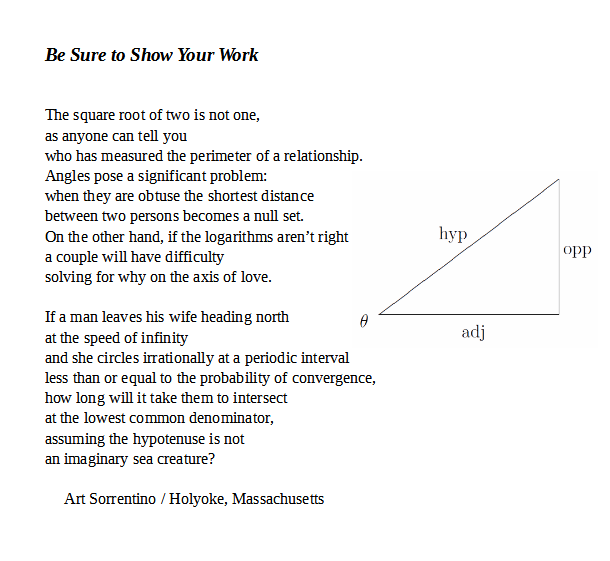
3rd Wednesday’s poem of the week from the winter issue – now on sale at Amazon.com.
“I Was In The Vicinity”
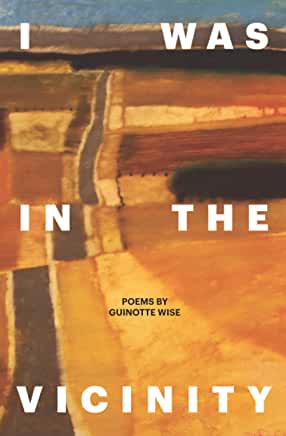 “Guinotte Wise returns with choppers and barns and the archaeology of the American experience, covid-19 edition. The chaff blowing over from the pyramids of silage must lend Wise some of its dry magic, as each of these poems shimmers with grace and prickly humor and life.”
 5-time Pushcart nominee and author of seven books, Guinotte Wise’s fiction collection Night Train Cold Beer won the H. Palmer Hall Award and his poetry and fiction have appeared in numerous journals including Rattle, Atticus, The MacGuffin and Southern Humanities Review. Some work is at http://www.wisesculpture.com
Publisher: Pski’s Porch
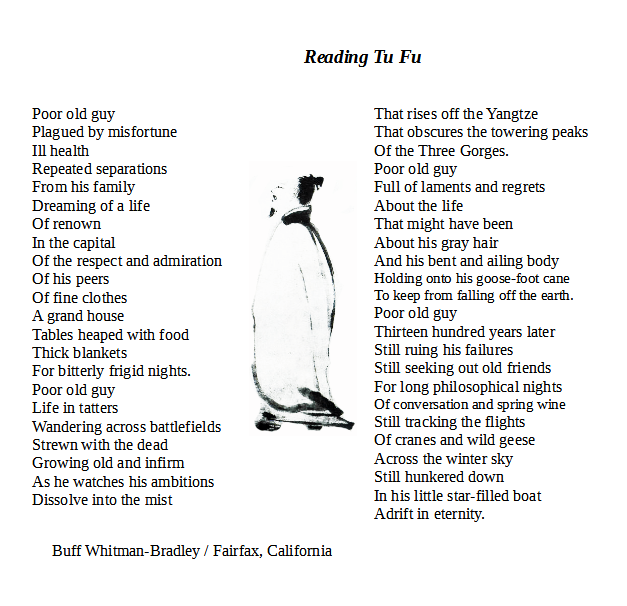
3rd Wednesday’s poem of the week by Buff Whitman-Bradley will appear in the winter issue due out later this month.
(Wayne State University Press, September 15, 2020)
 In a thrilling interconnected narrative, You’re in the Wrong Place presents characters reaching for transcendence from a place they cannot escape. Charles Baxter stated that “Joseph Harris has a particular feeling for the Detroit suburbs and the slightly stunted lives of the young people there…You’re in the Wrong Place isn’t uniformly downbeat-there are all sorts of rays of hope that gleam toward the end.”
The book, composed of twelve stories, begins in the fall of 2008 with the shuttering of Dynamic Fabricating-a fictional industrial shop located in the Detroit suburb of Ferndale. Over the next seven years, the shop’s former employees-as well as their friends and families-struggle to find money, purpose, and levity in a landscape suddenly devoid of work, faith, and love.
Vivid, gritty, and original; You’re in the Wrong Place is a love letter to the city of Detroit. A terrific book. (Julie Schumacher Thurber Prize–winning author of Dear Committee Members)
These stories come to us from the front lines of urban decay and renewal, telling us news that stays news. The book is compassionate in its understanding of an entire population group that is proud even in defeat, and the writing often rises to wonderful eloquence. This is a very powerful book. (Charles Baxter author of There’s Something I Want You to Do)
Like the city they struggle to live in, the Detroiters in Joseph Harris’s short stories lead lives ravaged by loss-lost jobs, lost homes, lost loves, lost lives, lost dignity, and lost worlds. And yet even among ruins, with the help of Harris’s artful prose and redemptive imagination, his characters salvage fleeting moments of makeshift grace. Here is a new voice worth listening to. (Donovan Hohn author of The Inner Coast)
Author Bio: Joseph Harris is the author of the story collection You’re in the Wrong Place (Wayne State University Press, 2020). His stories have appeared in Clackamas Literary Review, Midwest Review, Moon City Review, Great Lakes Review, Third Wednesday, Storm Cellar, and have been nominated for the Pushcart Prize. He lives in Oak Park, MI.
Story that first appeared in Third Wednesday: “Easter Sunday.” Third Wednesday Vol. X, No. 1. Winter 2017.
Purchase At: Wayne State University Press, Bookshop, Indiebound, Barnes & Noble, & Amazon.

See Phillip Sterling’s poem, “Opposite the direction we are traveling” in From his book, Animal Husbandry.
Phillip is an associate editor for poetry at 3rd Wednesday Magazine.
Opposite the Direction We Are Traveling / Phillip Sterling — Poetry Society of Michigan
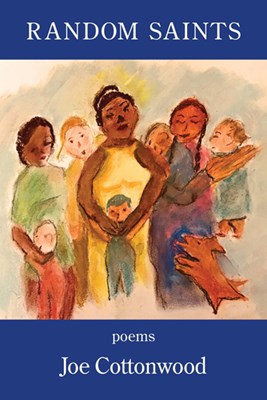 Random Saints by Joe Cottonwood
available at Kelsay Books and from Amazon.com.
In “Officially Licensed Poet,” the speaker says to the poet ‘I don’t really like poetry but I like your stuff.’ I really do like poetry and I like Joe Cottonwood’s stuff too. If I were asked to choose a book to encapsulate late twentieth century early twenty-first century life as told by a humane and gifted observer, Random Saints would be my pick. Cottonwood is a master story-teller. Put a log on the fire, pull up a comfy chair, open the book. Prepare to laugh, prepare to cry, prepare to feel better about the human race.
— Donna Hilbert, author of Gravity: New & Selected Poems
I have to say HOLY WOW. This whole thing knocked me over. Joe Cottonwood is a poet of uncommon perception. His work is direct, embodied, and authentic. Each poem is packed with the real wealth that comes of close observation and hard-won wisdom, carved down to the essence. Let Random Saints show you how the “grinding of the earth creates a diamond.” Then grab a few extra copies. You’re going to want to share this book.
— Laura Grace Weldon, Ohio Poet of the Year 2019, author of Blackbird
Joe Cottonwood’s humanity illuminates his beautiful poetry, unfailingly drawing us into kinship with our fellow beings—two-legged and otherwise—in ways that surprise and delight. His writing proves the power of simple words and everyday experiences. I was honored to publish so many of these pieces in The MOON magazine.
— Leslee Goodman, publisher of The MOON magazine Joe Cottonwood is a carpenter by day, poet by night. He lives under redwood trees in the Santa Cruz Mountains of California.

It’s November 10th and the temperature here in the mid-west will be in the 70s, a good time for an autumn poem. This one is a preview from our winter issue, due out in December.

 We Bury the Landscape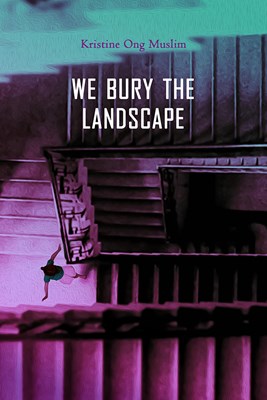
ISBN 978971542929-0
120 pages
Cover by Nadya Melina Nievera
Release date: October 25, 2020
Publisher: University of the Philippines Press
Click cover for link
“It isn’t everyday a book offers two very different ways of reading. The first: intensely personal, sometimes bewildering and yet rigorously demanding in terms of creative participation, and the second: intellectual, research-based and analytical, but also a call to a communal multi-genre artistic experience. These two different methods are on offer in Kristine Ong Muslim’s collection of micro fictions We Bury the Landscape, an assemblage of very short ekphrastic pieces.”
—Michelle Bailat-Jones in Necessary Fiction
“Although the relationship between painting and prose is certainly essential to fully experiencing this collection, the collection is more than an exhibition or exercise in ekphrasis … Muslim’s collection-exhibition chronicles the process in which the things we drown, discard, and bury are exhumed and continue to haunt us even after we have buried them again.”
—Hayes Moore in A cappella Zoo
“Conceptually, this is one of the most unusual books I have ever read. We Bury the Landscape, by Kristine Ong Muslim, is a collection of 100 mini-stories based on works of visual art—paintings for the most part, but also drawings, and one photograph …. The pieces themselves reflect the surrealism of the selection. They are flights of the imagination, untrammelled by pedantic considerations of plausibility. In effect, they are more in the nature of prose poems, where the language is every bit as important as the content.”
—Colman O Criodain in Gloom Cupboard
“It’s not the talking that is significant but the stories themselves that are important. We must accept the things we most want to query. All of which suggests that one strand of the weird invites us to reconsider entirely how we tell stories and how we understand them. I’ve been thinking about this every time I come back to Kristine Ong Muslim’s We Bury the Landscape.”
—Maureen Kincaid Speller in Weird Fiction Review
“[We Bury the Landscape is] filled with an uncanny wisdom about what terrifies us most in life and death—a knowledge so nonchalant and startling each poem proves only to reveal truths about each of us, about our humanity.”
—Susan Yount in Rebellious Magazine
Landscape with Grenade
after Cliff McReynolds’s Landscape with Hand Grenade / oil on panel, 1972
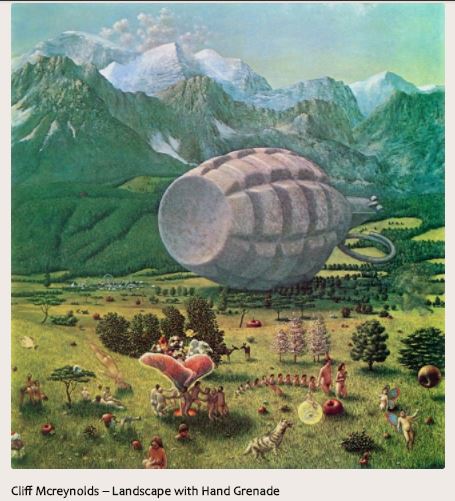 When the little people discovered the grenade on their valley, they did not know what it was so they prayed to it, tilled the land, and planted their tiny sacred crops around it as if it were some sort of shrine. Something so big and black with a curious contraption on one end had to beget miracles. So for months and months, they sang to it, asking for whatever it was little people desired in their little hearts. When nothing happened and because they were cowardly, they slit the throats of innocent animals in sacrifice. And when nothing happened still, they pelted the grenade with small stones. The grenade–god, of course, would not budge.
The Spider
after Odilon Redon’s The Crying Spider / charcoal, 1881
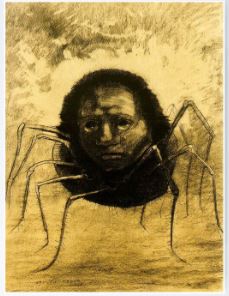 Your own family betrayed you the day they mistook you for a spider. Your mother caught you balancing a coffee mug on your fourth leg while sewing a button onto your coat with your two inborn hands. She told the family doctor you were “not quite right.” Another day, spying through the half-opened door, your kid brother watched you spin a web on the bedroom ceiling. Turning around, you lock eyes with him. He screamed. You didn’t get a chance to lick your achy joints and explain to him that it is normal to spin a web, to trap insects. Afterwards, your brother had to be sedated. For two years, he had the same bad dream. Your father, saddled since birth with pretending to be human, blamed you. When at last you had the sense to run away from home, nobody reported you missing. Your family must have assumed that anyone with eight legs must travel farther, go places no one else can. Most days, you wish that were the case.
Revenge of the Goldfish
after Sandy Skoglund’s Revenge of the Goldfish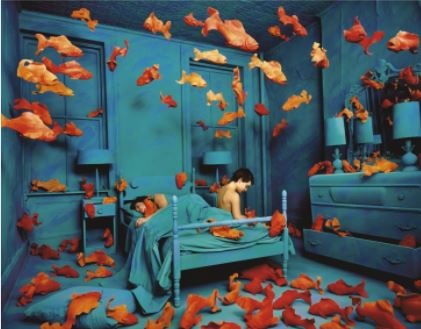 / art installation photograph, 1981
It started when my sister and I painted the bedroom walls an incestuous blue. At first, only two appeared, seeped through the walls. Goldfish. All fat lips and yellow-orange ugliness, squiggling as if they had the right to materialize. One landed near my sock drawer. The bigger of the two settled on top of the blue lamp. The fish wheezed as they died, waiting for water. It got worse each day. In a week, goldfish poured from the ceiling, the unadorned walls, the dresser mirror, under the blue bed. Hundreds. Their husks dropped on the floor. Even in our sleep, we could hear their gasps. We trod on their bodies as we dressed for work, back to the world that did not know what we had to endure inside this little room. We only collected them when we could no longer stand the smell, that pungent, moldy odor of decay. We talked of moving out, although by the time there was gurgling in the bathroom pipes, we knew it was too late.
 Third Wednesday Magazine