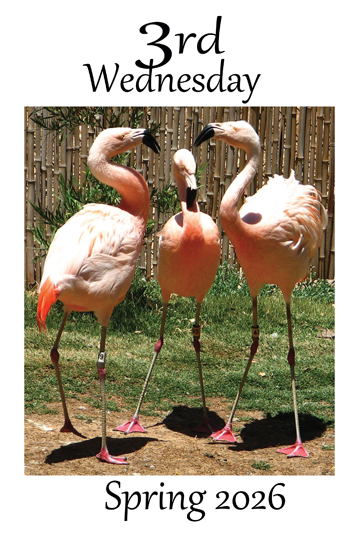
The spring issue of 3rd Wednesday is available for free download at our website. This issue includes winning poems and honorable mentions from our annual poetry contest.
The spring issue of 3rd Wednesday is available for free download at our website. This issue includes winning poems and honorable mentions from our annual poetry contest.
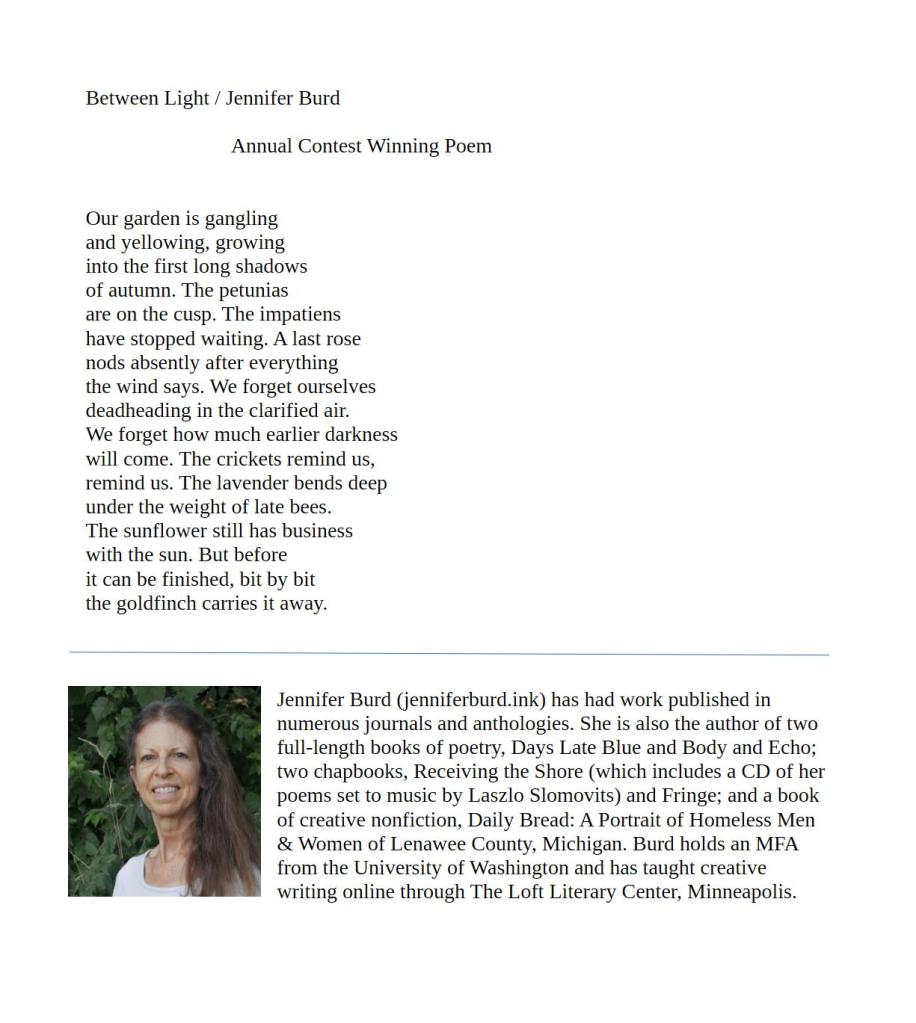
A winning poem in 3rd Wednesday’s annual poetry contest:
This relatively brief poem is ostensibly about a garden, but one that wastes no time finding its way, quietly and unexpectedly, into a very dark domain. Borrowing from the vivid vocabulary of more predictable poems about gardens, the speaker describes instead an environment in slow decay, while providing a warning that we, the observers, are blithely “deadheading in the clarified air.” I consider it a jarring but undeniably memorable poem, infused with the grim inevitability of mortality. – Marilyn L. Taylor, Contest judge.
I was 135. Then 125. Then 99. My big sister graduated and left for college. Ma said it from the sink—hands wet, eyes down: You’ll join her in two years.
Ma dressed me in my sister’s old clothes. Sleeves that swallowed my wrists. Cuffs worn soft where her fingers had worried them. I made Ma pack my sister’s usual lunch for me. At school, I dismantled it. Bread, cheese, ham, bread. The ham came off in a damp sheet. The cheese left a pale sweat on my fingertips. Her homemade cupcake—whipped peaks, chocolate curls—something I couldn’t separate without ruining.
A thick binder waited on my desk, rings yawning. The papers inside had my sister’s cursive in the margins. I pressed my pencil until the lead snapped. I reached for the eraser again.

Kimmy Chang is a Texas-based writer and computer-vision engineer. A 2026 Writers’ League of Texas Fellow and Pushcart Prize nominee, her work has appeared or is forthcoming in trampset, ONE ART, and Sky Island Journal, among others. Read more at https://www.kchang.xyz/.
Charlotte Collins sits cross-legged on a mat in a meditation room at Santosa Springs, a wellness retreat tucked in the misty Berkshire Mountains. Kel the guru is cute—Charlotte’s age, thirty, give or take—the type of guy Charlotte would have loved in her twenties, an enlightened, touchy-feely feminist in the body of a mountain biker, but those guys wanted to know her, wanted to look into her eyes and understand how she was feeling. Charlotte had no interest in swimming in the deep end of that pool.
“There’s a difference between chest and belly breathing,” Kel says. His biceps wink from his fitted hemp T-shirt.
Charlotte raises her hand, feeling her ponytail dance on her shoulders. “Breathing doesn’t usually work for me. I’ve tried, but it makes me more stressed.”
Charlotte’s inability to breathe is why her boss, Diana, VP of Commodities at JP Morgan, called her into her office. “Have you seen that PSA? Khakis and golf shirt type of guy, but then he starts fentanyl, and his face turns ashen and his skin becomes thin as cellophane.”
Jennifer Handford is a former high-school literature and composition teacher and is currently an MFA student in creative writing at George Mason University.
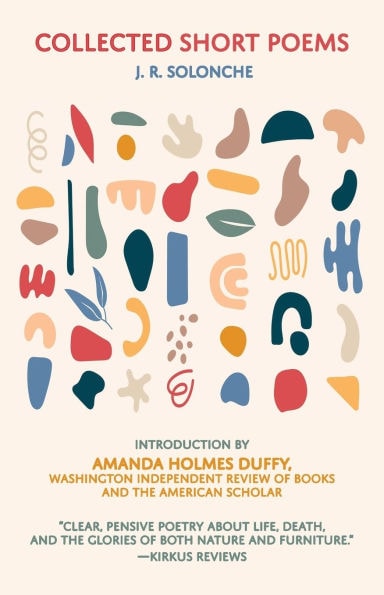
“Solonche’s volume of poetry skillfully captures the quotidian and the profound. These short works offer striking detail in succinct, evocative verses. One early poem, “Physical,” describes a doctor using a stethoscope as “offering me a box full of / his own collection of breaths, each / one better than mine.” The following poem, “To My Desk” celebrates the titular “hard and stubborn and loyal” piece of furniture, who won’t give up the secrets it holds: “No, not even if they torture you.” The juxtaposition reveals Solonche’s talent for finding beautiful metaphors for clinical experiences, and conjuring humorous, fulsome praise for everyday objects. Many poems are inspired by nature: “Stand Perfectly Still” and “Who Whispered” encapsulate the fleeting beauty of cherry blossoms. Rocks, lakes, animals, and storms are also fruitful subjects for Solonche’s keen but reflective style: “My Daughter Wants to Sit in the Shade” and “Private Property” combine levity with subtle commentary on the silliness of human pride and on the social contract. A series of works describing a partner suffering from dementia is particularly moving. Overall, the stylish yet straightforward tone of the pieces makes difficult subjects feel universal. Solonche’s powers of observation and careful shifts between subjects and tones make the collection consistently engrossing. That said, some readers may wish for longer treatments of weightier moral and philosophical subjects. Still, the works’ lucidity and humor make for a widely accessible collection.”
—Kirkus Reviews
“Solonche is productive and prolific, but that doesn’t water down his poetry… He can compress a philosophical treatise into three lines… His epigrammatic tidy poems are philosophic gems. Solonche sees humor and encapsulates it; he frames a thought in perfect verse… He’s playful and profound — the more he writes, the more he seems to know. Beneath the Solonche simplicity are significant social comments, and his goodwill reinforces the best in us.”
—Grace Cavalieri, Washington Independent Review of Books
“The tone is established from the outset: wry, wise, sardonic and playful, drawing the reader irresistibly in. Solonche is revealed as a philosopher in the mold of Wittgenstein: aphoristic, charismatic, acerbic and oddly mystical. If you met this book in a bar, you would definitely want to take it home with you and every day thereafter congratulate yourself on how lucky you’ve been. But that is true of all his books.”
—David Mark Williams
“These poem catch the reader off-guard in playful profundity. While always mindful of the tradition of poetry masquerading as direct statement (the likes of W.C. Williams, Robert Bly, Robert Creeley, and Charles Bukowski), J.R. Solonche nevertheless “makes it new,” through his masterful use of understatement, aphorism, word play, and anaphora—raising poem after insightful poem from the familiar and often overlooked “little things” of the poet’s day-to-day encounter with the world.”
—Phillip Sterling.
“According to Lord Polonius in Hamlet, “brevity is the soul of wit.” In the poetry of J. R. Solonche, brevity, soul and wit co-existsuperbly. Start with any of his poems. You’ll find, unlike much of what is written these days, the wit is never far from the surface. As for the brevity, imagine an appetizer that’s as filling as a main course. And, after the meal, after the laughter, the soul will be what lingers.”
—John Grey is author of What Else Is There, Main Street Rag’s Editor’s Poetry Series.
“These short poems are an extraordinary amalgam of wit, close observation, humor, and clear-seeing. Each one singles out and illuminates an ordinary moment— ordinary that is, until the poem explodes into a miniature epiphany. Easy of access and frequently profound, J.R. Solonche’s poems induce in me a state of delighted surprise.”
—Chase Twichell
“The history of book blurbs is littered with high falutin’ praise, whacky and wild metaphors, written to impress not to inform. All I need to say about J.R. Solonche’s poems is that they are good, really, really good.”
—John Murphy is editor of The Lake Contemporary Webzine.
“As someone who cut his teeth on ‘eastern’ verse, I’m no stranger to shorter poems. I’ve often heard it said that less time on stage means less can go wrong, i.e., shorter poems are somehow easier to write—an idea that I’ve always found ridiculous. With shorter poetry, there’s actually a lot more riding on every word, every syllable. But J.R. Solonche is more than up to the challenge. In this book, Solonche is sharing a lifetime of wit and experience, a whole library of bittersweet moments and insights—and all of it, free of pretension.”
—Michael Meyerhofer
“J.R. Solonche can pack so much humor and linguistic playfulness into such tight bundles, it feels like 1,000 clowns issuing from a VW Bug. He can also fit a lot of darkness and mortality into them, which feels more like 1,000 clowns dressed like Marilyn Mason issuing from a VW Bug. Solonche can be crass the way only the truthful can be, mischievous as a child with his hands in the honey jar, or even aphoristic and proverbial like a modern day Martial. Though he never know which Solonche you’re going to encounter on the next page, he’s a great bunch of guys to get to know.”
—Stephen Cramer is winner of the Louise Bogan Award and the National Poetry Series.
.
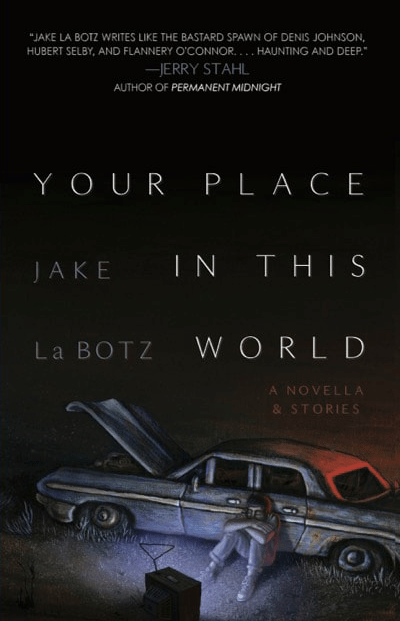
Jake La Botz writes like the bastard spawn of Denis Johnson, Hubert Selby, and Flannery O’Connor. His prose is as haunting and deep as the dark, beautiful, twisted heart of life itself. Your Place in This World is the kind of book you don’t just read, you stop people in the street and tell them they have to read. It’s that kind of good. I loved these stories.
—JERRY STAHL author of Permanent Midnight
La Botz’s dialogue is fierce and kinetic, revealing the back-alley wounds of survival that bloom beneath our skin. He ferries us through Chicago streets with the precision of someone who’s lived every note, every scar, every song. This collection vividly depicts the pulse of finding ourselves through the grit and end- less noise. Get a copy of this brilliant beauty, pronto. Sublime!
—MEG TUITE author of Planked by the Abyss
Jake La Botz’s Your Place in This World has an emotional depth and street-smart verisimilitude reminiscent of works from writ- ers like Saul Bellow, a gestalt of characters on the outs but still moving, still searching for meaning in a changing world. This book announces the arrival of a gifted new voice—a writer whose lyrical sensibility is eerily reminiscent of Kerouac and who understands how the convergence of place, personality, and circumstance can shape lives and destinies. An absolute feat of a debut.
—DANIEL PEÑA author of Bang: A Novel
Jake La Botz’s Your Place in This World is a vibrant and delightful ride through a ramshackle realm occupied by addicts and winos, truants and grifters, cheaters, dreamers, chumps, and bluesmen. This world’s denizens are hungry, urgent, funny, flawed, broken, resilient, and deeply human. In other words, they are us. Their dreams, schemes, and desires will resonate with readers who have at times felt marginalized or misunderstood. In this world there might not be redemption or even luck—just the reality of your existence, the prospect of a new day, and the sublime com- edy of life as you shuffle through the liminal spaces along the fringes of society, maybe, just maybe finding your place.
—LOUIS GREENSTEIN author of The Song of Life
In a collection that is understated and emotionally stunning, Jake La Botz explores the ache and beauty of the dispossessed. He evokes the grit of Chicago, and landscapes beyond, as his characters search for a way to belong. The tonal variations in these stories–from gritty to humorous to magically realistic–– are united by the leitmotif of flawed fathering, which gives a heartfelt and resonant undercurrent to this kaleidoscopic collec- tion. In the titular novella, the protagonist, like Joyce’s Stephen Dedalus, seeks a father figure to guide him, and finds a mentor in a bluesman who is both blessed and cursed by his ability to give voice to those who have passed on. La Botz’s searing details and ear for the longings of our imperfect lives create a collection of stories that shimmer against the dark world they illuminate.
—ELIZABETH ONESS author of The Hopefuls
***
A quirky Chicago kid raised by his junkie dad stumbles upon an unusual Maxwell Street bluesman; a Twelve-Step wannabe swaps addictions to match the support groups that meet in his favorite recovery room; a case of mistaken identity shines a bright light on a city-dweller’s dark past; a self-help seeking couple discover the help is more maddening than their “issues”; a tchotchke thief is overtaken by a force inside a stolen object. What does it mean to find your place in this world? Jake La Botz burrows his way deep into the challenges of revelation, showing how change can bless us and curse us, and ultimately save us.
Your Place in This World can be purchased at: https://www3.uwsp.edu/english/cornerstone/Pages/BOOKS.aspx
See a recorded reading from Jake’s new book on
3rd Wednesday’s YouTube channel:
https://youtu.be/cftvjZlbpWo

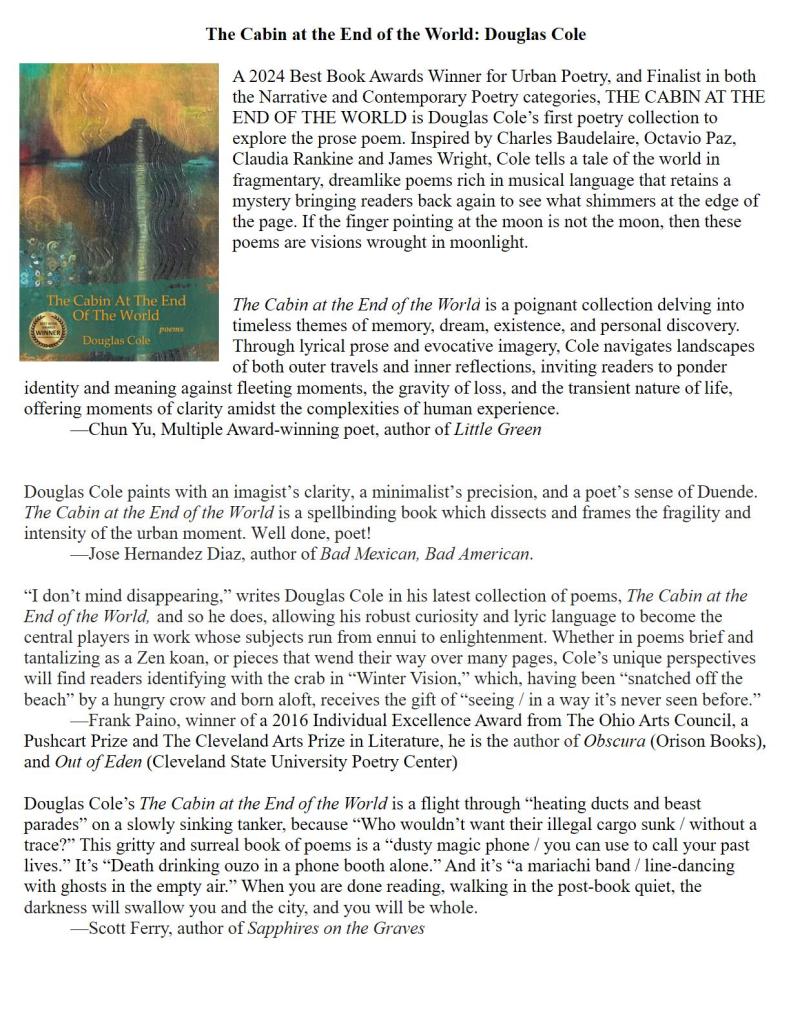
Douglas Cole has published two novels and eight poetry collections, including The Cabin at the End of the World, winner of the Best Book Award in Urban Poetry and the International Impact Book Award. The White Field, won the 2021 American Fiction Award, and his screenplay of The White Field won Best Unproduced Screenplay award in the Elegant Film Festival. His work has appeared in Beloit Poetry, Fiction International, Valpariaso, The Gallway Review and Two Hawks Quarterly. He also contributes a column called “Trading Fours” to the magazine, Jerry Jazz Musician. He received the Leslie Hunt Memorial prize in poetry, the Best of Poetry Award from Clapboard House, First Prize in the “Picture Worth 500 Words” from Tattoo Highway, and the Editors’ Choice Award in fiction by RiverSedge. He has been nominated Eight times for a Pushcart and Nine times for Best of the Net. His website is https://douglastcole.com.
A recorded reading by Douglas Cole can be found on 3rd Wednesday’s YouTube Channel.
Buy From Unsolicited Press