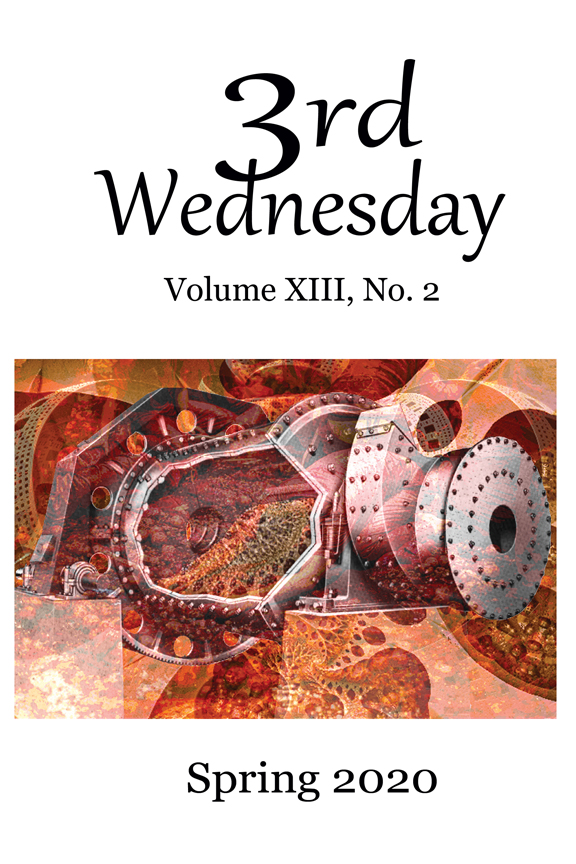
 The last 11 issues of 3rd Wednesday are avialable free in PDF format, including the latest spring contest issue. Visit our website and download some great reading. Poetry doesn’t go out of date.
The last 11 issues of 3rd Wednesday are avialable free in PDF format, including the latest spring contest issue. Visit our website and download some great reading. Poetry doesn’t go out of date.
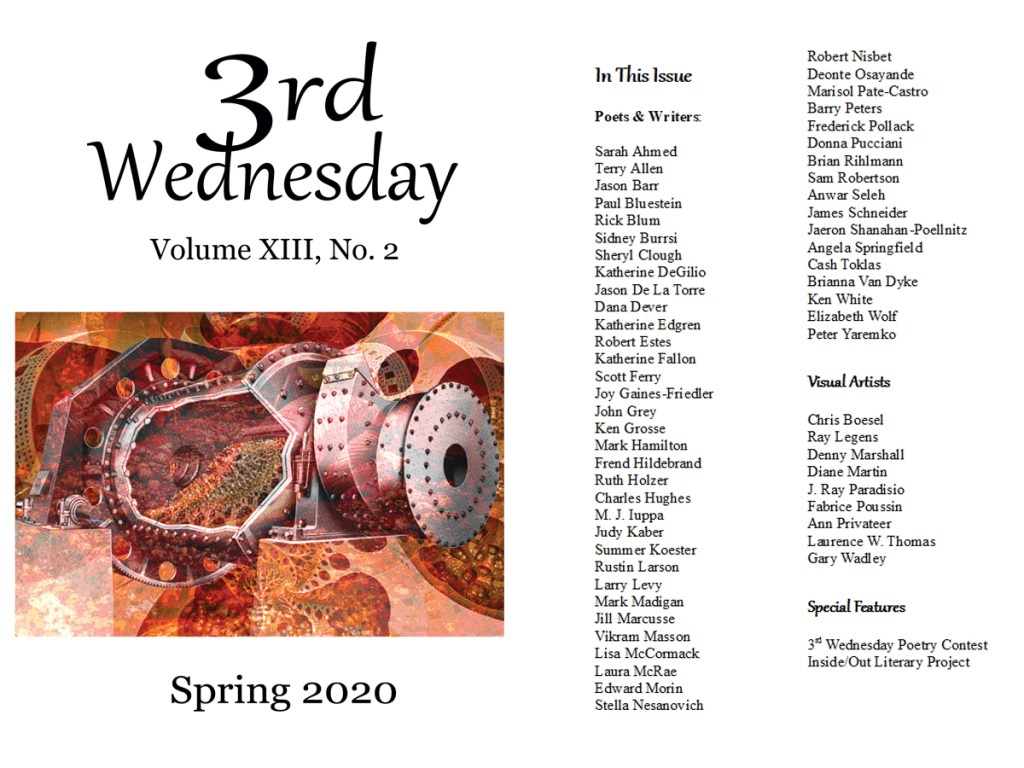
Contributor and Subscriber copies of the Spring issue of 3rd Wednesday are in the mail. This issue features the winning poems and honorable mentions from our annual poetry contest, judged this year by Marilyn L. Taylor. Dr. Taylor is a teacher and well-published poet with 8 poetry collections to her credit. She was poet laureate of The State of Wisconsin (2009-10).
A number of other poems that were originally entered in the contest have been published as regular submissions with permission of the poets. We give writers in our contests a second chance at publication when they elect that as an option.
This issue sees the return of the popular InsideOut Literary Arts Project, featuring five poems by Detroit area students in the 3rd through 5th grades. We owe the usual thanks to Peter Markus for curating them.
You can download the issue in PDF format for free from our website and print copies can be purchased at Amazon.com.
The spring issue of 3rd Wednesday is about to go into the mail. This is our annual poetry contest issue and today we present one of the honorable mention poems from this year’s contest. The poet tells us that this is her first ever poetry publication. The issue is on sale now at Amazon.

“To the Domain” is a black and white photo by Fabrice Poussin. It’s one of 10 pieces of visual art in the Spring issue of 3rd Wednesday Magazine due out next week.

Volume XIII, No. 2 is coming soon…
3rd Wednesday Magazine’s “Poem of the Week” is actually two poems from The InsideOut Literary Project, each written by 3rd grade students from Dearborn, Michigan. You can learn more about the project at their website, https://insideoutdetroit.org/
These poems and others from I/O are featured in the Spring issue of 3rd Wednesday (due out near the end of March) as will the winners from our annual poetry contest.


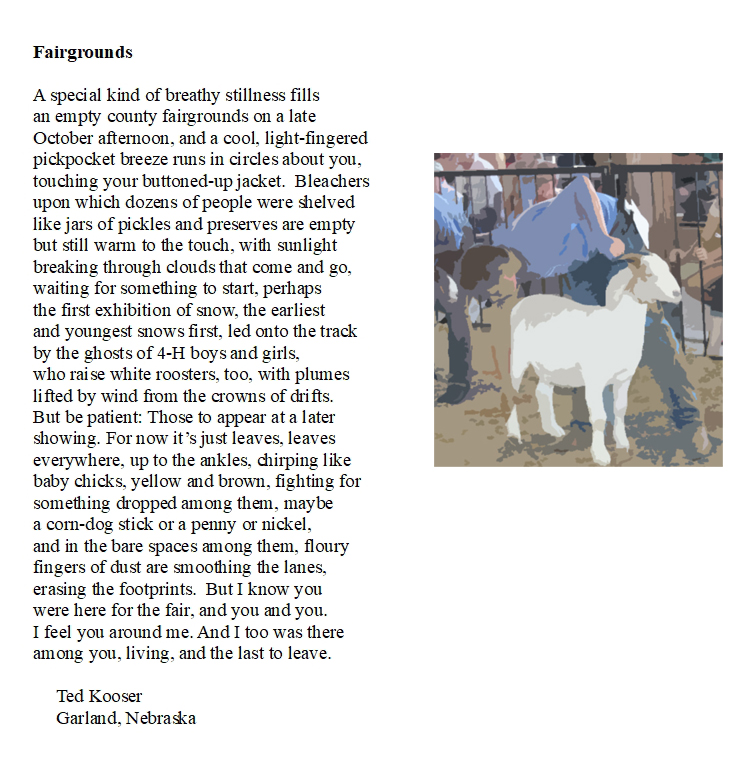
Our Poem of the Week was first published in fall 2018 issue of Third Wednesday. Here is Ted Kooser’s poem, Fairgounds.
For our 3rd Wednesday poem of the week we go back to 2015 and this jewel by our own associate editor, Marilyn Taylor. It has since had reprints in Poetry Magazine and at American Life in Poetry.
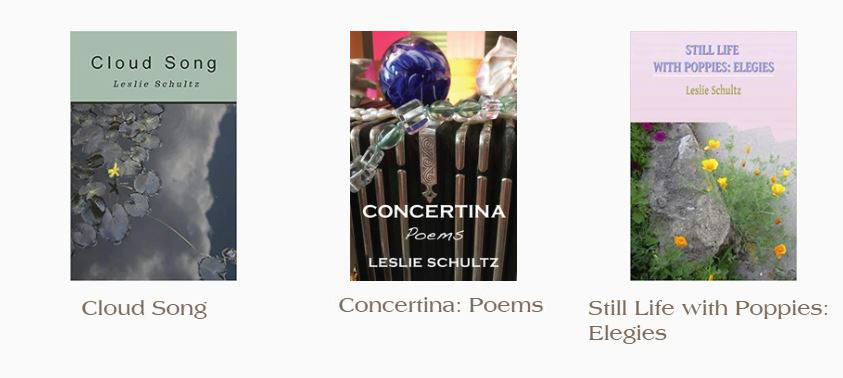
Available at Kelsay Books, Amazon & Content Bookstore in Northfield, Minnesota.
Leslie Schultz has been a frequent contributor to the pages of 3rd Wednesday Magazine.
Concertina
“Art sings a whole from a world in tatters,” writes poet Leslie Schultz in this remarkable collection. Schultz employs precise poetic forms to locate the “mineral music of our very bones.” The poems proclaim the material world – “the essential necessities… that make dreams real” – to celebrate poetry’s “ethereal alchemy.” Each poem creates a conversation between the poet and her many-layered audience. In “Open for Business,” the writer tells her father, “I’m still listening.” The poet’s voice here is accomplished, formal, witty, strange, and listening hard: to family stories, to nature’s notes, to the rooms of her house, to days “distinct with wonder.” In “Taproot,” a “crown” of 18 sonnets for and about Schultz’s great-great grandfather, each sonnet begins with the last line of the prior sonnet and transforms it to reshape the story. One sonnet turns an assertion to a question: “Can I build as lightly as birds/word shelters for the living and the dead?” This collection says yes. — Susan Jaret McKinstry
Cloud Song
In Cloud Song, Leslie Schultz is a master gardener. The beauty and abundance of her poetry springs from both a generous nature and a cultivated sensibility. Like the couple in her delightful character study “Gilbert’s Hobby,” she tends the “rampant garden” of free verse and the carefully shaped bonsai of formal verse with equal attention and skill. Her poetic garden is filled with sunlight and color and changing weather. What she offers is not an untouched Eden, but a real world populated by deftly-drawn characters existing in various states of fallen grace, a place where the poet’s attention always wanders from ideas of order toward the real beauty of the ephemeral: “sun slipping/behind the western trees, fish/tumbling in sparkles over the dam,/this garden in riots of color and seed.” — Rob Hardy
Still Life with Poppies: Elegies
Still Life with Poppies: Elegies by Leslie Schultz is what the name implies: bright joy against a sorrowful landscape. Death is everywhere in the world Schultz writes about—its relentlessness, its creativity, its suicidal call. Yet life in all of its various forms continues—some beautiful, some not. Cruelty may show its aftereffects for generations; a harsh set of comments may freeze creativity, at least for a time. While many may become cynical or depressed as a result, Schultz perseveres. Her poems about myth, in particular, are standouts. Schultz also understands in a profound way that the most emotional personal moments are mythical: emblemized by something as simple as plastic fruit in a blue bowl, or as iconic as a childhood home. For the depth of this understanding alone, you should read this book. — Kim Bridgford
 Leslie Schultz’s poetry has appeared in Able Muse, Blue Unicorn Journal, Light, Mezzo Cammin, Swamp Lily Review, Poetic Strokes Anthology, Third Wednesday, The Madison Review, The Midwest Quarterly, The Orchards Poetry Journal, and The Wayfarer; in the sidewalks of Northfield; and in a chapbook, Living Room (Midwestern Writers’ Publishing House). She received a Pushcart Prize nomination in 2017 and has twice had winning poems in the Maria W. Faust sonnet contest (2013, 2016). Schultz posts poems, photographs, and essays on her website: www.winonamedia.net.
Watch a video of Leslie reading on 3rd Wednesday’s YouTube channel.
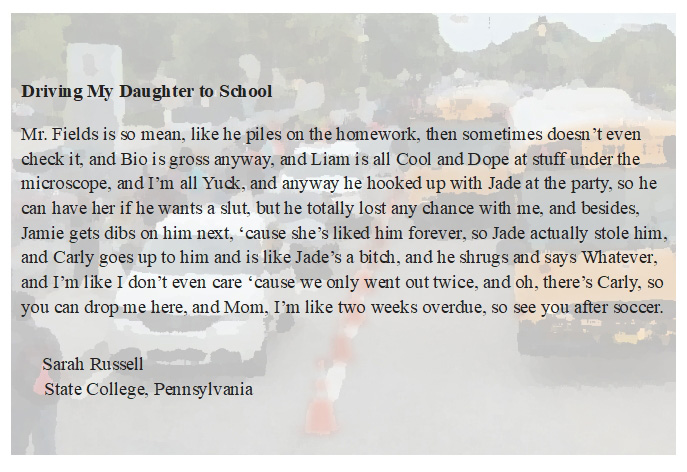
Sarah Russell’s poem was an entry and $100 winner in 3rd Wednesday’s recent One Sentence Poetry Contest. When we wrote to notify her, we told her that her’s was one of the worst run-on sentences we’ve ever seen, but that it served this prose poem perfectly.