Our Poem of the Week form poet, Kelli Russell Agodon. It appeared in Volume XII, No 3.
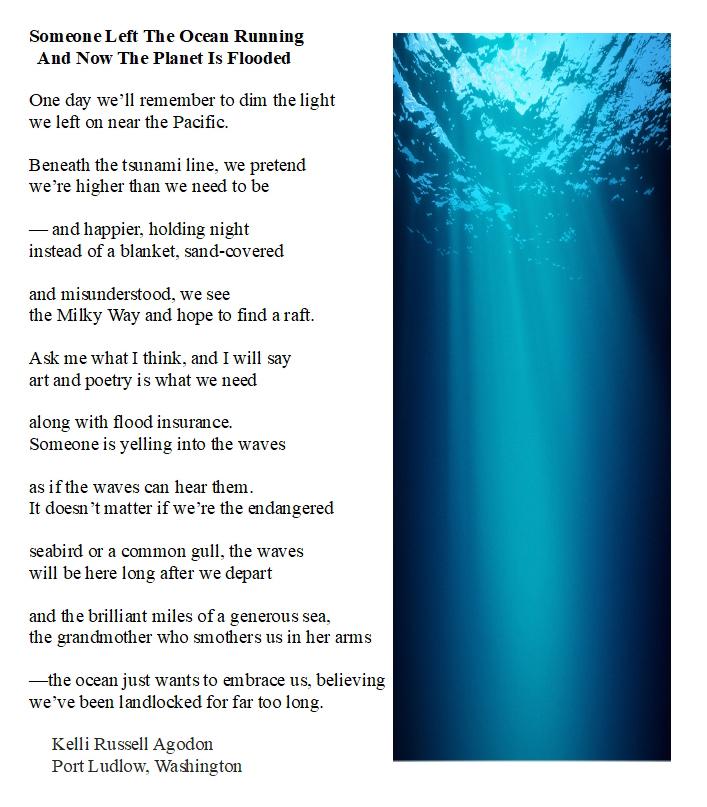
Our Poem of the Week form poet, Kelli Russell Agodon. It appeared in Volume XII, No 3.
 Hedy Habra is a 3rd Wednesday contributor of both poetry and visual art. Her poem, “Or Have You Ever Wondered Why She is Looking Back?” was featured Volume XII, No 2 of Third Wednesday and her painting Poet Under Pine Tree graces the cover of No 4.
Hedy has authored Under Brushstrokes and Tea in Heliopolis, winner of the USA Best Book Award. Her story collection, Flying Carpets won the Arab American Book Award’s Honorable Mention. A fourteen-time nominee for the Pushcart Prize and Best of the Net, her work appears in numerous publications. Her website is hedyhabra.com
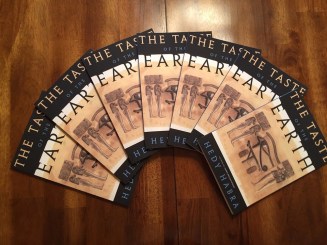
Her third book, The Taste of the Earthwas released on July 1st 2019 from Press 53 and is available from Press 53 and from Amazon
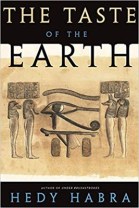 “The poems in The Taste of the Earth weave together personal history with the complex cultural heritage of Hedy Habra’s countries of origin. Steeped in memories, loss and longing, these poems invite the reader to revisit Egypt’s mythical past and Lebanon’s turmoil, recalling the intersecting roots of culture and language in an act of artistic recollection that bridges time and space. Through the lyrical power of the senses, Habra’s poems bring to life scenes of strife and upheaval as well as profound joy. Such images linger in the mind and keep evolving in search for the permanence of beauty within suffering as they are evoked by trees, houses, fountains and familiar objects, each voice offering with its testimony a broader perspective on the interconnectedness of worlds and universality of emotions.”
Editorial Reviews
The Taste of the Earth contains numerous histories—from Egypt’s distant past to the Lebanese Civil War to the Arab Spring—though history is not “the straight line that accompanies silence.” These poems confess that image can hide the smell of blood and the smell of jasmine, both the terrible and the sweet in the story of a place. Habra also teaches us that it is not just language and maps that tell history, but that objects carry what they have witnessed, the truths they are waiting to speak. —Traci Brimhall, author of Saudade
In this lush collection, the force of the lyric brings imagination, witness, myth, and memory into an opulent confluence. With formal variation—from the Japanese haibun, to the Malay pantoum, to an abecedarian composed of Phoenician letters, to an intersection of the senses and mathematics via the Eye of Horus—Habra’s poems enact art as the process of “remembering and forgetting,/telling and retelling.” As the focus here, often, is war and its devastations, witnessed and remembered, The Taste of the Earth is rife with sorrow songs, but each is moored by the speaker as a beholder of earth’s beauty as it pours in through the senses and finds a home in language: “[T]he jacaranda’s blue light anchors me back,” Habra writes, “whispering, yes, it’s here, deep inside, fluttering like a dove’s wings.” —Diane Seuss, author of Still Life with Two Dead Peacocks and a Girl
These are a painter’s poems, sensuous and filled with scenes under the surface. In her journey, Hedy Habra digs into the roots to find stories of wisdom. What’s special about these stories is that, even though they are painful, their exotic flavor is of earth, which belongs to everyone. They wander through memory and, image by image, settle in the soul “as sand in an hourglass.” —Dunya Mikhail, author of In Her Feminine Sign
You may be sitting in your favorite chair at home when you begin to read Hedy Habra’s latest collection of poems, The Taste of the Earth, but that’s not where you’ll be. You’ll be in Damascus, Heliopolis, Beirut, Aleppo. Before you know it, as if dreaming, you’ll be gliding along the streets of these cities, listening to their sounds, overhearing bits of conversation. Born in Egypt, Habra is part of the diaspora of Middle Easterners compelled to leave lands they love due to war and upheaval. There is longing for home in every sense of the word—for a place, a person, a taste, a story, a particular light, a language, a gesture, a laugh. It is this longing that makes these poems universal, regardless of where you are as you read them. —Susan Azar Porterfield, winner of the Cider Press Review Editor’s Prize for Dirt, Root, Silk.

 John L. Stanizzi is author of the collections – Ecstasy Among Ghosts, Sleepwalking, Dance Against the Wall, After the Bell, Hallelujah Time!, High Tide – Ebb Tide, Four Bits, and Chants. His newest collection, Sundowning, will be out this year with Main Street Rag. Besides Third Wednesday, John’s poems have appeared in Prairie Schooner, American Life in Poetry, The New York Quarterly, Paterson Literary Review, Blue Mountain Review, The Cortland Review, Rattle, and many others.
John is a teaching artist for the national recitation contest, Poetry Out Loud. A former New England Poet of the Year, John is the prose editor for the online journal Abstract Mag TV. He teaches literature at Manchester Community College in Manchester, CT and he lives with his wife, Carol, in Coventry.
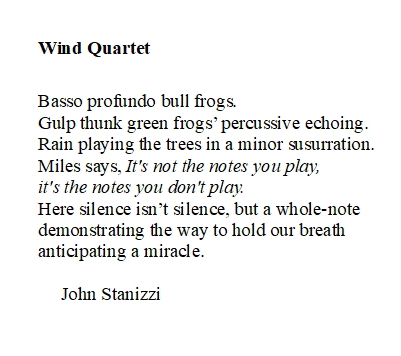
You can order John Stanizzi’s books at these links:
Hallelujah Time! (Big Table Publishing, 2014), Dance Against the Wall (Antrim House Books, 2012), Four Bits (Grayson Books, 2018), Chants (Cervena Barva Press 2019).
Just for fun, give it a go. Pick one of the colored tiles. The title of your poem is the printed name on the paint sample. Write your own poem in the reply section. It should be short enough that it would actually fit on a paint chip. We have no plans to do anything with these.

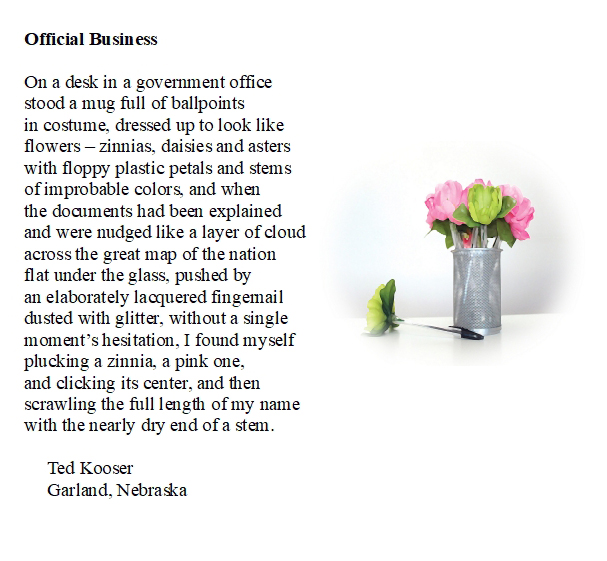
Though he didn’t intend it for our recent One Sentence Poetry contest, 13th Poet Laureate of the United States, Ted Kooser, sent us this example of what a poet can do with a single sentence.
 Phillip Sterling is the author of In Which Brief Stories Are Told (short fiction, Wayne State U. Press 2011), and six collections of poetry: And Then Snow (Main Street Rag 2017), And for All This: Poems from Isle Royale (Ridgeway Press 2015), Abeyance (Frank Cat Press Chapbook Award 2007), Quatrains (Pudding House 2006), Significant Others
 (Main Street Rag 2005), and Mutual Shores (New Issues 2000). He is the editor of Isle Royale from the AIR: Poems, Stories, and Songs from 25 Years of Artists-in-Residence (Caffeinted Press 2107) and Imported Breads: Literature of Cultural Exchange (Mammoth 2003) and served as the founding coordinator of the Literature In Person (LIP) Reading Series at Ferris State University, until his retirement in 2013. Phillip presently serves as an associate editor with Third Wednesday Magazine.
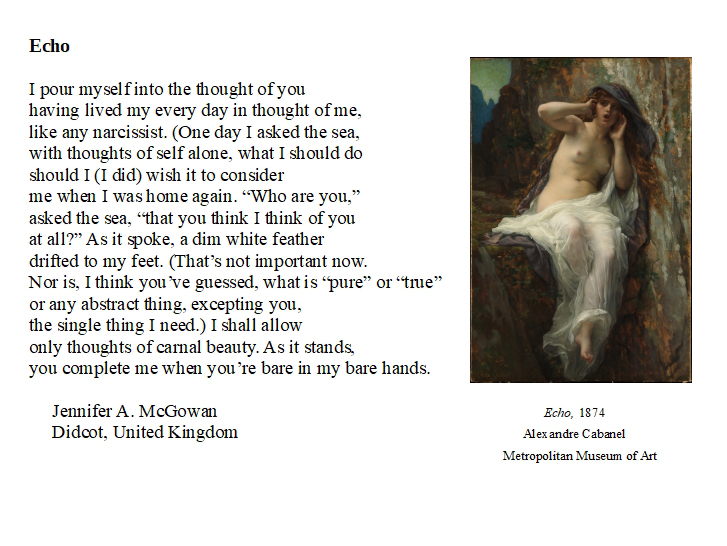
Our poem of the week comes from the Summer issue of 3rd Wednesday. It was part of series of mythology inspired sonnets by our featured poet, Jennifer A. McGowan.

A Grammar for Snow is available from unsolicited.com or richardluftig.com; $19.99 postage and handling included.
 3rd Wednesday contributor, John Sibley Willams is the winner of the Orison Poetry Prize for his poetry collection, As One Fire Consumes Another.
John Sibley Williams confronts the violent side of American history and its effect on our notions of self, fatherhood, and citizenship. […] The poems, which veer from elegiac to declarative to prayerlike, drill down into the beliefs and fears that underpin this violence.
–Poets & Writers
John Sibley Williams’ collection As One Fire Consumes Another transcends beyond the boundaries of family and history and country, beyond the body’s tragedies, the “silenced bones of others.” These poems rise as invocation, as testimonial to life’s unfiltered beauty, violence, and faith, to the “light . . . already in us.”
–Vandana Khanna, judge of The 2018 Orison Poetry Prize
 John Sibley Williams is the author of the poetry collections Skin Memory (Backwaters Prize), Disinheritance, and Controlled Hallucinations. He serves as the editor of The Inflectionist Review and has edited two Northwest poetry anthologies, Alive at the Center (Ooligan Press, 2013) and Motionless from the Iron Bridge (barebones books, 2013).
As One Fire Consumes Another is avialable from Orison Books and at Amazon.
 The Old Gardner Homestead
Each year, the forest reclaims more
of the old Gardner homestead
in the glen on the mountain;
but the crows still come
80 years after the family left.
They perch on an ancient oak,
looking out over the sapling-clogged field
as if harboring ancient memories of corn.
(First appeared in 3rd Wednesday, Volume VIII, No. 4)
Crossings, a chapbook by 3rd Wednesday contributor, Jude Dippold is available at Finishing Line Press or Amazon.
This small book of short poems encompasses a surprising span of the territory of the human heart. After you read Crossings, don’t return it to the shelf—keep it handy. Go back to it now and then. Open it to random parts and feel the pulse and poignancy of your own humanity reflected in this wise and wonderful mirror.
– Reginald Darling
Jude Dippold was educated and trained as a philosopher, spent his career working as an editor and communications specialist, and now finds refuge in the worlds of poetry and photography. He has spent most of his life on the edge of Allegheny National Forest where he found both solace and inspiration. He now resides in the North Cascades of western Washington and has traded the Allegheny River for the Skagit. In addition to Third Wednesday, his poetry has been published in literary magazines at Jamestown Community College, the College of Central Florida, and most recently in Exult Press’ “The Yes Book, Writings About Yes.”

