

Our “Poem of the Week” comes from the winter issue of Third Wednesday. It’s a single sentence from former Poet Laureate, Ted Kooser.
Our “Poem of the Week” is one of three winning poems from this year’s Annual Poetry Contest. Contest judge Robert Fanning said, “…what made these winning poems shine was a line or an image that astonished me, diction that flickered with deeper meaning, and an ear tuned to the extraordinary music of language.”

Well, you’ve got a book’s worth of poems and you’re not ready (so you think) to jump into the swamp of publishing or even to self-publish a book. What do you do with them? Maybe you just want to get them organized or you’d like to be able to finally show your poetry to friends or family but not put yourself out there to the general public. A self-publishing website like Lulu may be an answer.
Having your poems bound and printed is not the same as publishing. If you’ve written a lot, you’ve got poems in notebooks, journals and on scraps of paper shoved into drawers. If you’re the organized type, maybe you’ve even managed to put them together in a loose leaf binder. If you have, congratulations on at least getting that far, but it’s cumbersome to lug a binder around to open mics and other places you might want your poems at hand, and you probably have only that one precious copy. What if something awful were to happen to it or, worse, you should lose it?
Wouldn’t it be great if you had your poems in a small package with multiple copies so that you could always have them with you, would have copies to give away and so that you could never loose the only copy?
Most of the places we think of as self-publishing resources are little more than glorified,  highly automated on-demand printers that can print and bind a 6 by 9 inch trade paperback for less than the cost you can print your poems at home, considering the high cost of ink cartridges. Assuming you do your own layout using the templates they provide, most such places can print a book of between 50 and 100 pages for around five or six dollars per copy and, for that price, you even get a glossy cover of your own design.
The example I cited, Lulu Publishing, has options for not assigning an ISBN code to your book and for archiving your book privately so that only you can order copies. There is no minimum number of copies when you do order, no “initial print run”. You’re free to order one copy, or two, or five, or ten.
The template handles the complications like setting margins, paginating, page numbering and even automates the table of contents as long as you follow the page by page instructions that are embedded in the template. There is a separate online cover design module that allows you to upload a cover photo if you want one and choose fonts, background colors and patterns. Once you’re satisfied with everything, your .docx file will be converted to the PDF file that the printer requires and you can download a copy that shows you exactly how the cover and the interior pages of your book will look.
Once you approve the PDF, it’s time to print. You’ll have a hard “proof copy” in about ten days. Once you approve that, you can order as many or as few copies as you want any time you want at a price you can afford.
– David Jibson, 3rd Wednesday Magazine
Guinotte Wise has been featured often in the pages of Third Wednesday. He is a sculptor as well as a poet. You can see some of his work at http://www.wisesculpture.com/ . Here is our poem of the week.

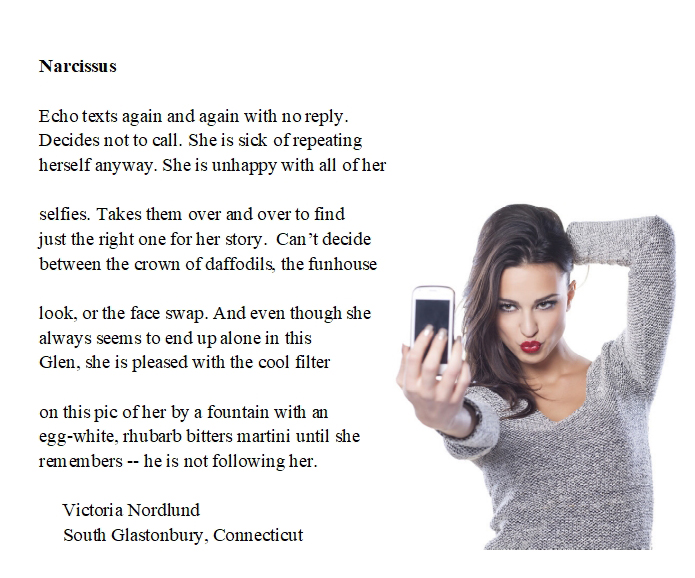
In Third Wednesday’s Poem of the Week, Victoria Nordland puts a modern twist on a Greek myth. This a preview from our spring issue, on its way to the printer now.
Our congratulations to Bruce Pemberton whose first published poem has been chosen for national distribution by American Life in Poetry.
It was first published in Third Wednesday.
Bellingham, Washington is a hotbed of poetry judging by the quality of the submissions Third Wednesday receives from there. We almost always find something worthy of publication. This one, by Sarah Murphy-Kangas, is a prime example. It’s Third Wednesday’s poem of the week.
In the U.S. we call them nighthawks but in much of the world they’re known as nightjars. African poet, Kim Ottavi, who now lives in France, writes about the nightjars of home. Here is the poem of the week from Third Wednesday Magazine.

 Third Wednesday Magazine